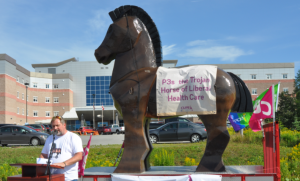
TransAqua made the right decision

MONCTON : The Greater Moncton Wastewater Commission -TransAqua – made the right decision not to pursue a public-private partnership for the upgrade of the wastewater treatment plant.

“We are pleased that the Commission decided to build the upgrades to the treatment plant using the traditional funding model”, said CUPE NB President Daniel Légère.

“This decision will allow the Commission to keep control over the management of the wastewater plant and the cost of the project. As well, this 80 million dollar project will be a great boost to the local economy.”

“After completing a thorough due diligence study process, the Commission came to the conclusion that a P3 project would be too costly for taxpayers.”

“We are calling upon the provincial government to go through the same due-diligence study process for the P3 nursing homes projects in Miramichi and Fredericton.”

“Across the country, we have examples where P3 projects have cost hundreds of millions more than if they had been delivered publicly. Last December, Ontario’s Auditor General found that P3 projects in that province cost at least $8 billion more over the last decade than they would have if they’d been publicly delivered. Fully $6.5 billion of that was due to the higher cost of private financing.”

“The government cannot wash its hands from its responsibility and leave the care of our seniors in the hands of for-profit companies”, concluded Légère.

Ambulance cut in Chipman another attack on rural New Brunswick

CHIPMAN: The Gallant Government is taking the wrong path with its attacks on
Healthcare services and rural New Brunswick.

“Yesterday, we were informed that one ambulance servicing the Chipman area would be eliminated by mid-June”, said Daniel Légère president of CUPE NB.

“It is obvious, this government has its sights on rural New Brunswick. Rural communities are more dependent on public services because of their distance from major centers. The government should be improving theses services instead of slashing what’s left in our communities”, said Légère.

“The Liberals of Brian Gallant were elected on a promise of creating jobs and growing the economy. Yesterday’s announcement does just the opposite. This decision from the government will affect between 8 to 10 fulltime and part-time paramedics”, concluded Légère.

Liberal government cuts ambulance services in Chipman

CHIPMAN: Ambulance New Brunswick has been directed by the Gallant Government to cut one ambulance stationed in Chipman.

“We have been informed this morning that one ambulance will be taken out of service in mid-June”, said Ralph McBride, coordinator for CUPE Local 4848, which represents the paramedics and dispatchers in the province.

“The paramedics staffing the ambulance will receive their 30-day layoff notices tomorrow. This decision from the government will affect between 8 to 10 fulltime and part-time paramedics.”

“Right now, four ambulances cover the Minto-Chipman-Mill Cove area. Two of the ambulances are stationed in Chipman. Under the Dynamic Deployment System used by Ambulance NB when one ambulance is responding to an emergency call, they still have one ambulance as backup. This decision to eliminate one ambulance will have an impact on services offered in Boiestown, Doaktown, Stanley and even Fredericton.”

“Health Minister Victor Boudreau seems to think of profit over patient safety and care. Once more, the Brian Gallant Government is targeting rural New Brunswickers and is showing us they don’t care about the wellbeing of New Brunswickers; they only thing that seems to matter is balancing the books,” concluded McBride.

Urgent Care hours to be reduced at St. Joseph’s Hospital

Saint John: The hours of operation at the St. Joseph’s Hospital Urgent Care Department will be reduced to the bare minimum as of May 1st.

“It has been brought to the attention of CUPE Local 1252 that the operating hours of the Urgent Care Department will be reduced by 4 hours by the end of the week,” said CUPE Local 1252 Coordinator Ralph McBride.

“The current hours of operation now runs on a 12-hour day and will be reduced to an 8-hour day service instead. St. Joseph’s Hospital provides a valuable service to the residents of Saint John, especially those who live in the Southern Peninsula.”

“This move is not only going to increase the wait time at the Saint John Regional Hospital, but it will also place unnecessary hardship on people that cannot afford the transportation cost to the regional facility.”

“The people in that area either walk to the facility for care or take a short taxi ride, if this care is needed after hours then they will be looking at a longer more expensive taxi ride which then means they could have to make a choice between food or their health,” said the President of CUPE Local 1252, Norma Robinson.

Norma Robinson is very concerned with the province’s decision, which she feels is unfair to those who are less fortunate.

“Now, the government wants to cut an additional 10% which is the equivalent to $250 millions to Health Care Services. It seems this government is willing to place people who are living at or below the poverty line in jeopardy regardless of their needs.”

“It is important that the people of the Saint John region speak up about this new reduction in service or what will be next. They should be contacting their area MLA to voice their concerns” concluded Robinson.

CUPE NB: Daniel Légère re-elected President

FREDERICTON: Delegates at the CUPE NB 52nd Annual Convention reelected Daniel Légère as president, last weekend in Fredericton.

Daniel Légère told the delegates that he was committed to work for advancement of the workers’ issues.

“We have many challenges in front of us this year. We need to stop the Gallant Government’s austerity agenda.”

Convention delegates adopted an action plan to fight the government’s austerity agenda. The plan will focus on the mobilization of CUPE membership. “We will reach out to New Brunswickers. We need to stop the erosion of our public services.”

“We need to protect public services for all New Brunswickers. We can’t let the government slash public services.”

Daniel Légère, a member of CUPE Local 1251, was first elected president of the Division in 2005.

Rally for Equality and Solidarity

Women on the March until we are all free: Rally for Equality and Solidarity

In front of the NB Legislature, Fredericton, 12 noon, Friday, April 24, 2015

New Brunswick will join the International World March of Women 2015 in a global day of action on Friday, April 24, which marks the second anniversary of the horrific Bangladesh factory collapse that killed 1,135 workers. The focus of this year’s march is precarious work.

The New Brunswick rally, to be held at the NB Legislature at 12 noon on Friday, April 24, 2015, is part of a global social movement that aims to eliminate the causes of poverty and violence against women. This year’s theme is “Freedom for our bodies, our land and our territories.”

Approximately, 100,000 people in New Brunswick, almost one in seven, live below the poverty line. Almost one third of single-parent households in New Brunswick are poor, according to 2011 statistics.

Following the most recent economic crisis, governments have been implementing austerity budgets and New Brunswick is no exception. New Brunswickers are still struggling for pay equity, access to reproductive health care and child care.

Elsipogtog women made international headlines when they put their bodies on the line to defend their territories against shale gas. Maya women in Guatemala are demanding justice in Canadian courts for rape and murder committed by a Canadian mine’s security guards. Rape is a weapon used in wars around the world.

More of us are demanding action be taken for our missing and murdered indigenous women and girls and making the links to capitalism, colonization and destruction of the land.

This global feminist movement brings together diverse groups, including women’s groups, unions, anti-poverty groups, Indigenous activists, international solidarity groups and many others. Since the first March in 2000, activists have organized local, national and global marches, hundreds of workshops and actions and lobbying of governments and international organizations.

Speakers:
Odette Robichaud, CUPE NB VP and liaison to the CUPE NB Division Women`s Committee
Phylomène Zangio, Common Front for Immigrant Women and Visible Minorities
Tanna Pirie-Wilson, Female Aboriginal representative, National Aboriginal People’s Circle, Public Service Alliance of Canada, on missing and murdered indigenous women and girls
Johanne Perron, the NB Coalition for Pay Equity – Coalition pour l’équité salariale du N.-B.
Sorcha Beirne, Fredericton Youth Feminists
Wendy Johnston on Snapshot on Women and Poverty in NB from the Common Front for Social Justice.
Amély Friolet-O’Neil, Regroupement féministe du Nouveau-Brunswick
Speaker TBA, Reproductive Justice NB
Astrid Deurloo, Fredericton Gender Minorities Group
Tracy Glynn, BTS Guatemala-Maritimes Solidarity Network, on Canadian mining and sexual violence.
Daniel Légère, president of CUPE NB, on reinstating the Advisory Council on the Status of Women
More speakers TBA.

The 4th International World March of Women was launched on March 8, International Women’s Day, and will conclude October 17, 2015, International Day for the Eradication of Poverty.

More info here: http://www.mmfqc.org/english
Info : http://www.mmfqc.org/mouvement
Contact: tracy.a.glynn@gmail.com.

Federal cuts to Health Care need to be reversed

MONCTON: About fifty people demonstrated today outside the constituency office of Conservative Member of Parliament Robert Goguen to mark the one-year anniversary of the expiration of the Health Accord.

The demonstrators demanded the renewal of the Health Accord.

“Since the 10-year Health Accord negotiated between the federal and provincial expired, the federal Conservatives have already reduced health care funding by $987 million.” said Odette Robichaud, CUPE NB vice-president.

“In New Brunswick the transfer cut is about $17,5 millions this year. This reduction is equivalent to 44 hospital beds or 240 long term care beds.”

“Over 10 years, New Brunswick will lose approximately $ 715 million.”

“The refusal of the conservative government to renew the Accord puts our system of public health care at risk.”

“The Health Accord provided the provinces with stable funding and sets national standards and ensured that in every province, we received the quality health care we needed.”

“Already we are asking overstretched health care workers to do more for less. The Conservative cuts need to be reverse,” concluded Robichaud.

Paramedics Union disappointed in government stalling tactics

Fredericton: The Union representing the New Brunswick Paramedics, CUPE local 4848, is disappointed with the government tactics to delay the adoption of a legislation which would allow first responders to access Workers’ Compensation coverage for Post-Traumatic Stress Disorder (PTSD).

“Last week, the government supported the principle of a Private Member Bill that proposed amendments to the Workers’ Compensation Act. The amendments would allow first responders to be eligible for workers’ compensation for PTSD without having to prove that their condition is work-related”, explained Denny Cogswell, spokesperson for CUPE 4848.

“Bill 15 was adopted in second reading by the members of the Legislature but it’s more than likely that it will never come back for a third reading. It seems the government will not fully support the amendments until lengthy studies and more detailed information can be obtained.”

“This is very disappointing. We are seeing more first responders suffering from PTSD and we need to have a system in place that will give them the help they need at an early stage.”

“Similar legislation was adopted in Alberta three years ago and other provincial jurisdictions are following in their footstep. We urge government to work with the opposition parties on this really important legislation and not delay any further the adoption of those amendment which will streamline the process for first responders seeking help for PTSD,” concluded Cogswell.

Does New Brunswick really have a structural deficit? Commentary by Toby Sanger

The New Brunswick government is engaged in extensive province-wide consultations focused on finding $500 to $600 million in spending cuts or increased revenues to address what it claims is “a serious fiscal challenge.” It says this is necessary because the province has a “$400 million structural deficit” has “been spending beyond its means,” and additional funds are needed for other initiatives.

There’s just one big problem with this exercise: the province doesn’t have a “structural deficit”. It’s not that the emperor has no clothes: it’s that he’s hiding them and pleading poverty instead.

A “structural deficit” is a deficit that continues to exist even when the economy is operating at its full potential output with full employment, while a “cyclical deficit” is one that exists because the economy is operating below its potential.

If anything, the province has a structural surplus. New Brunswick’s current deficit at $255 million for 2014/15 is a cyclical deficit that is shrinking fast and will soon become a surplus when the economy recovers to its full potential.

New Brunswick, with its unemployment rate at 10 per cent, has a lot further to go to reach its full economic potential. Let’s say we consider full employment to be when the unemployment rate is down to five per cent. With five per cent higher employment and output, the province’s own source revenues, now estimated at $4.98 billion this year, would be about five per cent, or $250 million, higher. These higher revenues and lower spending resulting from lower rates of unemployment would be more than enough to eliminate its current $255 million cyclical deficit.

If that isn’t enough, the province could increase revenues by further reversing some of the ill-conceived tax cuts brought in just before the economic crisis. New Brunswick’s revenues are now 25 per cent of the province’s economy, a full percentage point below its long-term average of 26 percent. Returning to the long-term average would generate additional revenues of $320 million.

The province’s program spending at 24 per cent of the economy is just slightly below its long-term average of 24.1 per cent and in the mid-range for Canadian provinces. Clearly New Brunswick isn’t “spending beyond its means”, but is collecting revenues below its means—and should take steps to increase revenues in a fair and progressive manner, as I’ve outlined elsewhere.

The problem with making further spending cuts now is it will slow down the recovery and make the return to fiscal balance that much more difficult. Spending cuts have a much larger negative impact on the economy than tax increases do, particularly when the economy is operating below capacity

We saw the same mistakes made by the previous government. Four years ago the Alward government, assisted by former TD Bank economist Don Drummond, also exaggerated how bad the province’s fiscal situation was. This was used to justify significant program spending cuts while the economy was still recovering. New Brunswick was the only province to cut overall program spending in 2011/12. This may have temporarily reduced the deficit, but it resulted in the worst economic slump in 30 years. Unemployment soared to rates above those during the financial and economic crisis and the lower revenues resulted in higher deficits.

In the fall election, New Brunswickers rejected the previous government’s austerity measures and poor economic record and elected the Gallant government instead with its promises to create jobs and grow the economy.

Unfortunately, the Gallant government seem to have misplaced their jobs and growth platform when they entered their executive offices and picked up the previous government’s austerity program instead. They even hired Prime Minister Harper’s former deputy minister of Finance Michael Horgan (instrumental in implementing federal austerity measures) to chair New Brunswick’s strategic program review advisory committee.

If New Brunswick doesn’t have a structural deficit, why is the government pretending it does? The best I can guess is they’re doing this for political purposes: so they’ll have extra money to spend just before the next election. But that seems to be what the Alward government was planning—and it didn’t turn out too well for them, or for New Brunswickers.

Instead the Gallant government should focus on and consult on what it was elected to do: create jobs and growth. This should involve getting employers, labour, community groups and educators together to work out ways to grow New Brunswick’s economy, create good jobs and add value to its resources. These might be more challenging discussions than just asking people where to cut, but ultimately they’ll be more productive and beneficial.

If the province’s recent history has shown anything, it’s that you can’t cut your way to growth and that if you manufacture a fake crisis, you may end up with a real one.

Toby Sanger is the economist for the Canadian Union of Public Employees and previously served as chief economist for the Yukon government and principal economic advisor to the Ontario Minister of Finance. He produces the quarterly Economy at Work, a weekly Eye on the Economy and also recently published Deficit Déjà Voodoo: is New Brunswick really headed off the fiscal cliff?